
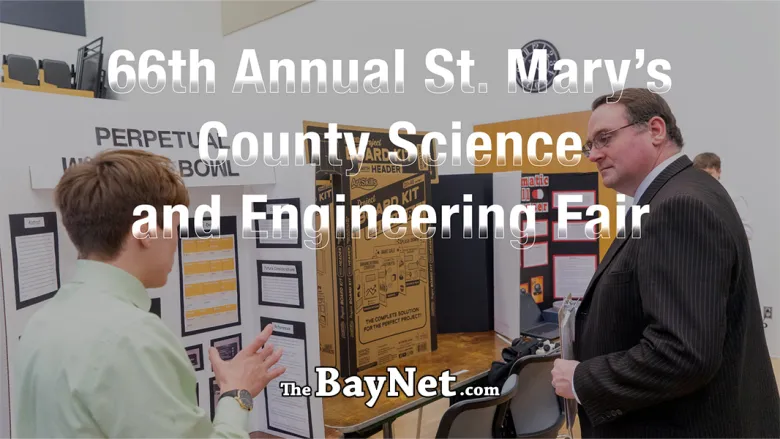
CALIFORNIA, Md. — The 66th annual St. Mary’s County Science and Engineering Fair was held Friday, bringing 153 middle and high school students together to present original research projects in science and engineering.
The fair took place inside the Southern Maryland Autonomous Research and Technology Building on the University System of Maryland at Southern Maryland campus. A total of 138 projects were entered, representing students from public, nonpublic and home schools across St. Mary’s County.
Senior Division Grand Awards were awarded to Diana Wyman for her project Nature’s Solution to Microplastic Pollution and Paul Savvas for his project InfantGuard. Junior Division Grand Awards were awarded to Andrew Ellerbe for Stick to the Beat and Camille Winings for Motion Controlled Robot Rescue Hand. The awards were presented at Great Mills High School Friday evening.
Projects were judged across junior, grades six through eight, and senior, grades nine through 12, divisions with students interviewed by judging panels during the event. Exhibits spanned 22 categories and were required to meet safety and size regulations set by the Prince George’s Area Science Fair Association and endorsed by the St. Mary’s County Science and Engineering Fair Board.
First and second place winners from the St. Mary’s County Science and Engineering Fair were invited to advance to the Prince George’s Area Science Fair, a regionally represented event, scheduled for March 20 and 21. Senior Division Grand Award winners at the regional level may qualify to compete in the 2026 Regeneron International Science and Engineering Fair to be held May 9 through 15 in Phoenix Ariz.
Annette Ragland, a judge and longtime event organizer, said the 66th annual St. Mary’s County Science and Engineering Fair was a countywide academic event that showcased student driven research across science and engineering disciplines. She said students from public, private, parochial and home schools participated each year in junior and senior divisions and were evaluated on their use of the scientific method, creativity and innovation.
Ragland said the fair has grown in scale and quality and that this year represented one of the largest events in recent memory with a noticeable increase in project sophistication. She emphasized that students are not only completing experiments but developing skills in problem solving, iteration and presentation.

“To my knowledge, this is one of the largest fairs we have had in a long time and the most projects we have had in a while,” Ragland said. “The level of the projects this year has taken a step up. I think they increase every year and this year is no exception.”
A Longstanding Countywide Effort To Showcase Student Innovation
The St. Mary’s County Science and Engineering Fair is led by a volunteer board made up of members from industry, nonprofit organizations and academia. The nonprofit coordinated the annual fair and supported student advancement to regional and international competitions.
Jason Hayes, vice president of the St. Mary’s County Science and Engineering Fair Board, said the 66th annual fair continued a decades-long effort to showcase student achievement in science and engineering across public, private and parochial schools in the county.
Hayes said the fair provided students in grades six through 12 with an opportunity to present original science and engineering projects to judges and the public. He said the experience also helped students build confidence and communication skills. Hayes mentioned that student enthusiasm and initiative stood out this year, with many students actively engaging judges and welcoming them to their projects.

“It is a way to showcase grades six through 12 from public, private and parochial schools, and give students a chance to show the judges what they are able to do and how uniquely they think,” Hayes said. “They want to be here. They love science. They love engineering and they just want to show what great things they have come up with.”
Hayes explained that student participation is coordinated through school-based science fair coordinators who work closely with the county fair board and align requirements with the Prince George’s County Area Fair and the Regeneron International Science and Engineering Fair.
Mark Ragland, president of the St. Mary’s County Science and Engineering Fair Board, said the 66th annual fair marked one of the largest competitions the county has held in recent years, with 138 student projects representing middle and high schools across St. Mary’s County.

“We always have a plethora of students whose projects are unbelievably impressive,” Ragland said. “We even get judging comments saying this is the sort of work you would see at the collegiate level.”
Ragland said the fair served as the county-level gateway to regional and international competition, with first and second-place winners advancing to the Prince George’s County Area Science Fair. Students who earned top honors at the regional level may advance to the Regeneron International Science and Engineering Fair.
“The science fair is one of the first big opportunities students have, to do independent research and practice presenting it to be judged,” Ragland said. “Those awards and recognitions can be built into portfolios.”
Student participation reflected both strong academic preparation and access to local research resources, including mentorship opportunities connected to higher education institutions and scientific organizations in the region. Ragland said the fair provided students with early experience in independent research, professional presentation and public speaking while also offering opportunities for scholarships, special awards and resume building.

A University Setting Connects Student Research To Real-World Engineering
Hosting the fair inside the Southern Maryland Autonomous Research and Technology Building also connected student research to higher education and workforce pathways in the region. Niku Letang, Coordinator for Recruitment and Outreach with the University System of Maryland at Southern Maryland and the University of Maryland Clark School of Engineering, said the facility was designed to support applied engineering education and autonomous systems research.
Letang said the building, which opened about four years ago, provided students access to professional-level resources including 3D printing and machine labs, and one of the largest wind tunnels in the state. She said hosting the county science fair in the space reflected a shared commitment to hands-on STEM learning and exposed students to real-world engineering environments.

“This is a great location to have the St. Mary’s County Science and Engineering Fair,” Letang said. “[University] students don’t just have classes here. They work on projects and gain hands-on experience, bringing engineering into the classroom from a practical perspective, not just academic.”
Letang said participation in science fairs helped students demonstrate initiative, problem-solving skills and applied learning beyond the classroom, all of which strengthen college and career portfolios. She added that the Southern Maryland campus allowed students to earn University of Maryland engineering degrees locally, creating a direct pathway from K-12 STEM programs to higher education and regional career opportunities.
A Snapshot Of Student Innovation Across The Fair
Susanna Nilsson, a 10th grade student at Great Mills High School, presented Forever Chemical Cleanup Combos, an advanced environmental science project examining whether combining bioremediation techniques could improve the removal of polyfluoroalkyl substances, commonly known as PFAS, from contaminated water.

“My project tested to see what bioremediation techniques removed a higher concentration of forever chemicals from water than any one of them on their own,” Nilsson said. “Currently wastewater treatment plants are not effective in removing forever chemicals from water and they are linked to various health conditions.”
Nilsson said her project tested the effectiveness of biological agents, including bacteria, plants and fungi, both individually and in combination, to determine whether they could remove higher concentrations of PFAS than single methods alone. She used fluorescein as a PFAS surrogate and analyzed results using a spectrophotometer.
Abril Esparza and Angela Hou, seniors at Great Mills High School, presented an engineering project called iCane (pronounced eye-can), an affordable smart cane designed to enhance independent mobility for blind and visually impaired users.

Esparza and Hou said the project addressed a key limitation of traditional white canes, which cannot detect obstacles above ground level. While commercial smart canes exist, they said those devices are often prohibitively expensive and not designed with daily user needs in mind. They said they wanted to create a lightweight, low-cost assistive device that complements existing cane techniques rather than replacing them.
“Our goal is to enhance mobility for the blind community by creating an affordable smart cane,” Hou said. “Commercial smart canes do exist, but they cost from $600 to $6,000, and most insurance companies are not willing to cover it.”
The iCane prototype used an Arduino microcontroller, ultrasonic sensors and vibration feedback to alert users when obstacles are detected within a set distance. Testing showed consistent detection accuracy while keeping the device weight within 10 percent of a traditional white cane and significantly reduced cost compared to commercial alternatives.
“The ultrasonic sensor sends out a high frequency soundwave that bounces off the object, and it measures the time of flight from that echo, and then it uses the speed of sound to calculate the distance,” Esparza said. “For our data, we had a 100 percent accuracy across our trials.
Genevieve Coughlon and Devin Moses, seniors at St. Mary’s Ryken High School, presented a psychology and behavioral science project that examined how multitasking with music affected memory recall.

“I like to listen to music as I am studying, so I wanted to know, does this affect my study methods?” Coughlon said. “Current research shows that students often cannot multitask, and it even has a negative effect on their academics, so we wanted to take this study and see it in action.”
Coughlon and Moses designed an experiment involving 30 student participants divided into two groups — one listened to heavy metal music, and the other to classical music — while completing a secondary task.
“We would change the experiment into three groups, with one control group, and that could have completely changed the results of our experiment,” Moses said.
Samuel King, an 11th grade student at Great Mills High School, presented an engineering design project focused on creating an unmanned aerial vehicle (UAV) intended for disaster relief operations.

“It is a vertical takeoff and landing fixed-wing UAV for disaster relief,” King said. “It allows a disaster relief team to take off in an environment where there might be obstacles nearby, and you are not able to have the traditional horizontal takeoff.”
Rather than testing a hypothesis, King said his work centered on engineering design, modular construction and real-world constraints faced by disaster relief teams. The aircraft featured adjustable wings, a modular electronics tray to manage center of gravity, detachable components for transport, and a dual battery system optimized for different flight modes.
Antonia R., an eighth-grade student at Spring Ridge Middle School, presented a prototype of a dog-powered scooter aimed at helping people with limited mobility exercise energetic dogs safely.

“The objective of this project was to build a scooter that a dog could pull, and the scooter has to have a reliable turning mechanism and be stable enough to support a person’s weight,” Antonia said.
Antonia’s project focused on solving real world design challenges related to stability, turning and rider safety. She said the scooter was engineered to support a person’s full weight while allowing controlled leaning during turns, a key design feature that required careful placement of the center of rotation to prevent tipping.
“If you have ever ridden a scooter or a bicycle you will notice that when you are turning, you want to lean into the turn, and so this scooter does that,” Antonia said. “The reason that this is important is because if the turning mechanism is above the center of rotation, then it flops, and I did not want the project to flop over.”
Téa Combs, an eighth-grade student at Spring Ridge Middle School, presented her project the Fuzzy Companion Part Two, a therapeutic engineering project designed to reduce stress and anxiety through a responsive stuffed animal prototype.
Combs’s project built on her earlier work and used Arduino circuitry, vibration motors and sensors embedded inside a handmade plush squid to simulate the calming presence of a living animal. The device responds to touch by vibrating in a very subtle way.

“I created a stuffed animal squid that vibrates to help with people who have a lot of stress and anxiety,” Combs said. “The results were that the altogether average was that the [participant’s] heart rate went down 4.4 beats per minute.”
Combs conducted structured testing with 30 participants across three age groups ranging from early childhood to adults. Using a heart rate monitor, she measured physiological responses before and after interaction with the device. She said results supported her hypothesis that the device could help reduce stress and anxiety.
Kyle VanRyswick, an eighth-grade student at St. Michael’s Catholic School, presented a chemistry-based project that examined how different beverages affected tooth enamel through discoloration and structural damage.

“My project is what effects do drinks have on the teeth,” VanRyswick said. “I was using eggs because eggshells are mostly made out of calcium.”
VanRyswick submerged the eggs in various beverages for extended periods, including 40 hours and then 64 hours, to observe changes over time. His testing compared energy drinks, sodas, sweet teas and tap water.
VanRyswick said his results showed that energy drinks caused the most discoloration and shell damage, with dark sodas producing the most visible staining overall.
“I also found shell damage,” VanRyswick said. “My conclusion is that energy drinks discolored the eggs and also damaged the eggs the most.”
From middle school prototypes to senior-level research, the St. Mary’s County Science and Engineering Fair highlighted how student curiosity, supported by educators and volunteers, continued to drive science and engineering forward in St. Mary’s County.
Results Of The 66th Annual St. Mary’s County Science And Engineering Fair
Grand Award Winners
Senior Division
- Diana Wyman – Nature’s Solution to Microplastic Pollution
- Paul Savvas – InfantGuard
Junior Division
- Andrew Ellerbe – Stick to the Beat
- Camille Winings – Motion Controlled Robot Rescue Hand
Senior Division Category Winners
Behavioral and Social Sciences
- 1st Place: Jessica Wilkinson and Nigel Haley – Classical Music Effect on Vitals by Sex
- 2nd Place: Genevieve Coughlon and Devin Moses – Effects of Multitasking on Memory Recall
Biochemistry
- 2nd Place: David Turner and Mason Bowden – Hair Curlers Healthy or Not
Biomedical and Health Sciences
- 1st Place: Sydnee Krieger and Grace Wilcox – Patellar vs Stimuli Reflex Times
- 2nd Place: Jennifer Pack – The Best Defense
Chemistry
- 1st Place: Ruhi Sheth – Open Air’s Effect on Vitamin C in Orange Juice
- 2nd Place: Carley Greenwell – Ibuprofen Solubility
Computational Biology and Bioinformatics
- 2nd Place: Rishi Sheth – In Silico Modeling of CAR T Failure in ALL
Earth and Environmental Sciences
- 1st Place: Susanna Nilsson – Forever Chemical Cleanup Combos
Embedded Systems
- 1st Place: Paul Savvas – InfantGuard
- 2nd Place: Jane Venendaal – Alert Today, Alive Tomorrow: Early Warning Systems for Blind Intersections
- 2nd Place: Logan Riley – Camera Equipped Ratchet
Engineering Technology: Statics and Dynamics
- 1st Place: Samuel King – Modular Autonomous Fixed Wing VTOL UAV for Disaster Response
- 2nd Place: Connor Denihan – 3D Printed Laptop Screen Support
Environmental Engineering
- 1st Place: Diana Wyman – Nature’s Solution to Microplastic Pollution
- 2nd Place: Sterling Muchnick – Reducing Erosion Using Natural Materials
Materials Science
- 1st Place: Samantha Francino – Lichtenberg Wood Burning
- 2nd Place: Vivian Carey – Smart Screen Stitches
Robotics and Intelligent Machines
- 2nd Place: Collin Haycraft – Ember One
Systems Software
- 1st Place: Amilia Hernandez Toro – HowRUFeeling? An AI Powered Journal
- 2nd Place: Noah Sebaa – Seatsaver
Technology Enhances the Arts
- 1st Place: Angela Hou and Abril Esparza – iCANe: Enhancing Independent Mobility for the Blind Community
- 2nd Place: Cassandra Thompson – Next Gen Hologram Intelligence
Junior Division Category Winners
Behavioral and Social Sciences
- 1st Place: Edgar Naiva – Does Age Affect Whether People Think AI Is Real?
- 2nd Place: Phinnaeus Mikulewicz – What Is Random?
Biomedical and Health Sciences
- 2nd Place: Madison Zackman – No Need for Caffeine
Biomedical Engineering
- 1st Place: Jacob Lovelace – Magnetohydrodynamic Blood Pump
- 2nd Place: Morgan McCormick – Object Detecting Glasses
Chemistry
- 1st Place: Soraya Rinaldi – Delay or Decay: Shelf Life’s Best Brew
- 2nd Place: Adriana Liwanag – The Effect of Music on Crystal Growth
Earth and Environmental Sciences
- 1st Place: Amaris Shick – VOC Emissions: Hot Cars, More Compounds?
- 2nd Place: Alyssa Russell – Crassostrea virginica Filtration Rates
Energy: Sustainable Materials and Design
- 1st Place: Thomas Fucito – Tiny Turbines, Big Possibilities
- 2nd Place: Ellis King – Eco Ethanol
Engineering Technology: Statics and Dynamics
- 1st Place: Antonia Ruminski – The Allie Skid
- 2nd Place: Nathan Nilsson – Spring to Light
Environmental Engineering
- 1st Place: Joseph Ross – Eco Brick
- 2nd Place: Olivia Shedd – Black Gold: An Experiment in Composting
Materials Science
- 1st Place: Izaiah Walker – Voltage Wars: The Electrolyte Challenge
- 2nd Place: Isaac Neall – What Hat Will Stop Skin Cancer?
Physics and Astronomy
- 1st Place: Denzel Briscoe – From Short to Tall: Does Height Affect Shot Accuracy?
- 2nd Place: Noah Galapon – Shooting Power and Accuracy
Plant Sciences
- 1st Place: Alex Vo – Rooted Resistance
- 2nd Place: Oscar Neto – Effects of Radiation on Organisms
Robotics and Intelligent Machines
- 1st Place: Camille Winings – Motion Controlled Robotic Rescue Hand
- 2nd Place: Paxton Spatig – Blindsight
Technology Enhances the Arts1st Place: Andrew Ellerbe – Stick to the Beat


To read the original article on theBayNet.com, click here
